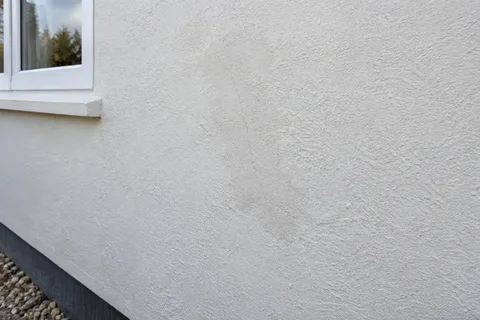
Separate the mark from the wall condition
Marks beside a driveway: clean before choosing a coating
A marked strip of render beside a driveway can make an otherwise tidy elevation look neglected. The immediate temptation is often to wash it aggressively or cover it with a fresh colour. Before choosing either, establish what the surface is and whether the source of the marking remains. A decorative coating may be appropriate, but it should follow an assessment of the wall and a suitable cleaning approach rather than replace them.

On this page
Describe the pattern without guessing the cause
For a Wilmslow rendering enquiry, photographs of the whole elevation and the affected strip help explain the setting. Note where the marks begin and end, whether they concentrate below a fitting and whether they have changed over time. A band beside paving can have several possible explanations. Its position alone does not prove one particular source or establish that the render has failed.
Consider nearby rainwater fittings and the way the adjoining ground is used, but leave diagnosis to appropriate assessment where needed. SPAB's rainwater guidance explains how leaks and concentrated wetting can affect masonry and finishes. It does not mean every driveway-side stain comes from a gutter. The useful approach is to identify the actual source rather than apply a familiar explanation to a photograph.
If there is physical damage as well as discolouration, describe it separately. Cracking, detachment and erosion may require a render repair assessment before decoration. A mark can be primarily superficial, while another apparently similar area may involve defects beneath the surface. Keeping those observations distinct helps the proposed work remain proportionate.
Identify the surface that will be cleaned
A textured silicone system, a painted mineral render and traditional lime work can need different care. Product records are helpful if available. Where the installed finish is uncertain, the contractor should establish enough information to choose a suitable method. A general claim that one cleaning treatment is safe for every exterior is not an adequate basis for work.
The retained coating also matters. Cleaning may reveal weak paint or an old patch that was less obvious while the surface was dirty. That does not necessarily mean the cleaning caused the underlying defect, but the method and findings should be understood. The scope should explain how unexpected condition changes are reviewed rather than automatically moving from washing to coating the whole wall.
For lime-rendered masonry, compatible treatment and the condition of older fabric deserve particular care. Do not select an aggressive process simply because the owner intends to repaint afterwards. A later coating cannot undo unnecessary damage to the substrate. Relevant specialist advice may be needed before choosing the cleaning or decorative route.
Use a controlled trial to judge the response
A trial should show whether the proposed method removes the relevant material without unacceptable effects on the finish. Choose a representative position and review it at the appropriate stage, including after the surface has reached a suitable condition for judgement. A wet cleaned patch can look different from the surrounding dry wall, so immediate appearance alone may mislead.
The trial can also help distinguish achievable cleaning from permanent variation or underlying damage. If the mark remains, the next decision should respond to that finding rather than simply intensify the treatment without considering the material. The contractor should explain the options and their limitations. The aim is a useful result on this surface, not proof that every discolouration can be removed completely.
Keep a photograph and brief note of the method and location. These records are especially useful if more than one surface or finish is present. A successful trial on one area does not automatically establish suitability everywhere on the property. The treatment should remain linked to the material and condition it was tested on.
| Matter | What to establish |
|---|---|
| Source | Why the mark is occurring and whether it continues |
| Surface condition | Whether the coating and render remain sound |
| Cleaning response | What an appropriate trial achieves without damage |
| Final appearance | Whether cleaning, repair or compatible decoration is justified |
Resolve an ongoing source before decorating
If the assessment identifies a leaking fitting, defective junction or another continuing source, include its correction in the project. The relevant work may require a different trade, but it should not be left as an informal suggestion after the coating has been agreed. Identify who arranges it and when it is completed. A new colour can hide evidence temporarily without preventing it from returning.
The driveway setting may also require practical protection during the work. Vehicles, neighbouring surfaces and pedestrian access need an arrangement suited to the cleaning and coating method. Follow appropriate product and site requirements, including control of the work area where people use the route. A narrow drive is not the same working environment as an empty open wall with no adjoining property.
The contractor should also explain how the cleaning operation and any residues are managed within the site plan. Include sensitive adjoining materials and planting in that discussion rather than assuming that a treatment suitable for render is suitable for everything beneath it.
Compare cleaning, repair and coating as separate outcomes
If suitable cleaning leaves the wall serviceable and the appearance acceptable, further decoration may be unnecessary. If local defects remain, repair may be needed before any broader finish. If the surface is sound but the owner still wants a new colour, a compatible recoating project can be considered. These decisions should be made from the findings, not bundled together automatically.
A silicone-rendered wall needs care and any later coating appropriate to its installed system. A coarse finish should not be presumed to require pebbledash removal solely because its texture holds visible marks. Removal is a larger intervention with consequences for the background. It deserves its own assessment rather than being presented as the inevitable next step after an unsatisfactory cleaning result.
If decoration is selected, define its boundary. Coating only the lowest strip may create a deliberate two-tone effect or an awkward band, depending on the design. Review the intended colour on the actual texture beside the retained surface. A full-elevation coating may provide a different appearance, but it still requires compatible preparation and should not be justified by a promise to erase every change in plane or grain.


Retain a useful baseline after the work
Photograph the completed area and keep the product or cleaning information with any repair record. This provides a baseline if the marking returns. A future assessment can then consider the timescale and location rather than start again with an unexplained stain. If a source was corrected, retain that detail too, including the responsible trade's information where relevant.
For a wider wall refurbishment, keep the driveway-side findings in the elevation schedule. The rest of the wall may have a different condition and should not automatically inherit the same treatment. A good result can be modest: suitable cleaning, a corrected fitting and a clearly defined local repair may do more useful work than an unnecessary replacement finish.
The decision is easier when each stage answers a specific question. Establish the mark's context, identify the material, test an appropriate method and then choose the finishing scope. That sequence makes the new appearance a consequence of understanding the surface, with a maintenance record that will still be useful after the immediate improvement has become familiar.
Common questions
Will pressure washing remove the marks?
That cannot be assumed, and an unsuitable method can damage a finish or adjoining details. Identify the surface and relevant cause, then use a method supported for that material, with a controlled trial where appropriate. This guide is not a recommendation to experiment with high-pressure cleaning on an uncertain wall.
Can the lower wall simply be painted a darker colour?
A darker colour may be an aesthetic choice on a suitable surface, but it does not resolve ongoing wetting, damaged render or contamination. Establish the cause and condition first, then specify compatible preparation and decoration with a deliberate boundary.
See housing and planning information for Wilmslow and nearby places, including the source and geography behind each figure.